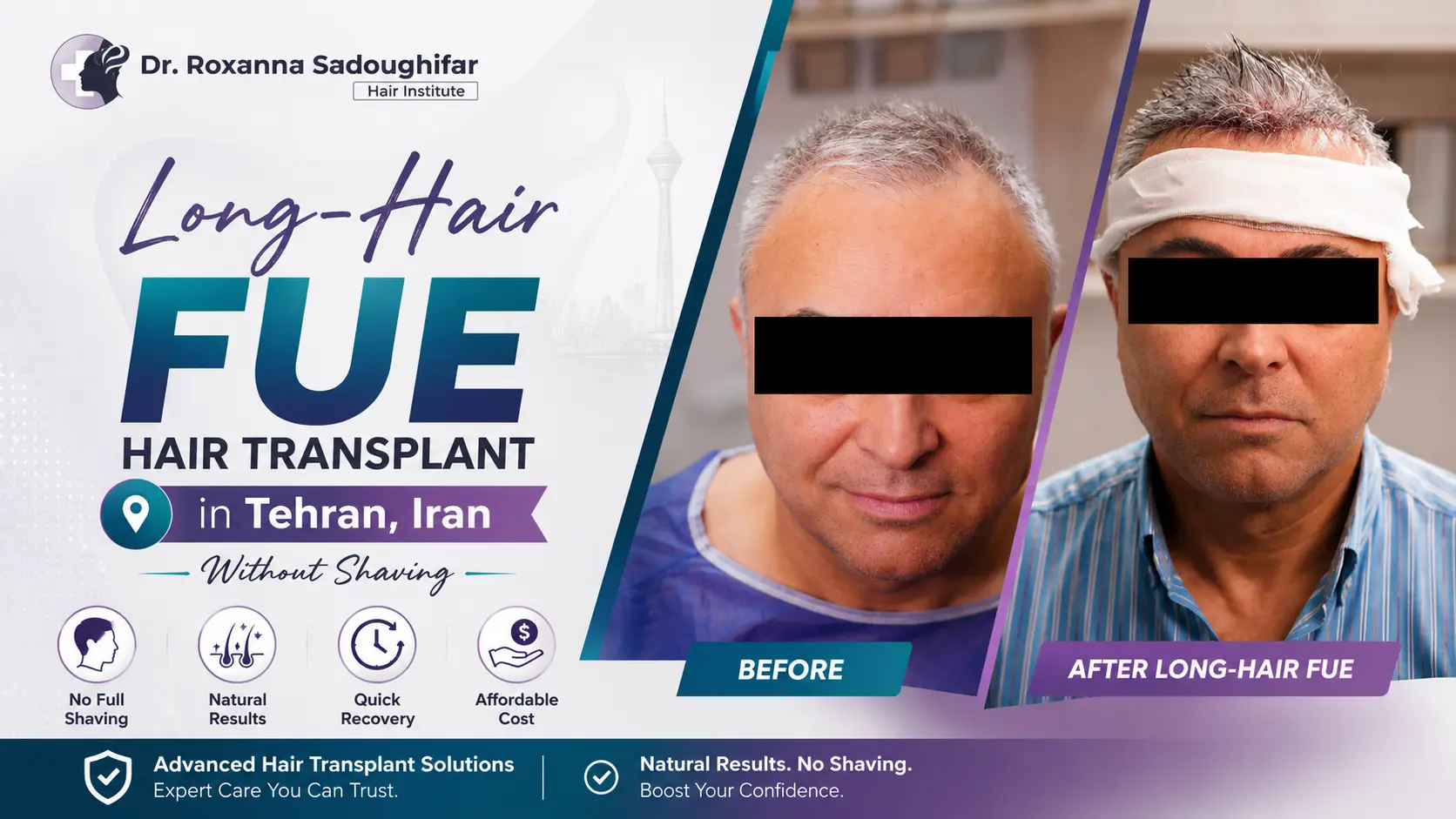
Are you considering a hair transplant but worried about shaving your head before the procedure?
For many people, the thought of having their hair noticeably shaved is one of the biggest reasons they postpone hair restoration. Professionals, public-facing individuals, people with upcoming events, and anyone who simply wants to keep their hair transplant private may prefer a more discreet approach.
At Dr. Roxanna Sadoughifar Hair Institute in Tehran, Iran, long-hair FUE hair transplantation offers a solution for appropriately selected patients who do not want the traditional shaved appearance.
Also known as Long-Hair FUE, No-Shave FUE, or Unshaven FUE, this advanced approach is designed to harvest and transplant follicular units while preserving the visible length of the hair as much as possible. The goal is simple: restore thinning areas while helping you maintain a more natural appearance during the early stages of recovery.
What Is Long-Hair FUE Hair Transplant?
Long-Hair FUE is an advanced variation of Follicular Unit Extraction (FUE). In a conventional FUE procedure, the donor area is commonly shaved or closely trimmed to allow the surgeon to clearly identify and extract individual follicular units. With Long Hair FUE, specialized techniques allow selected grafts to be harvested while keeping the hair shafts long. The transplanted grafts can retain their visible hair length, creating what is often described as a “preview” of the transplant immediately after placement.
However, patients should understand that the visible transplanted hair is not the final result. The transplanted hairs may shed during the normal post-transplant cycle, while the follicles remain in place and later produce new hair growth.
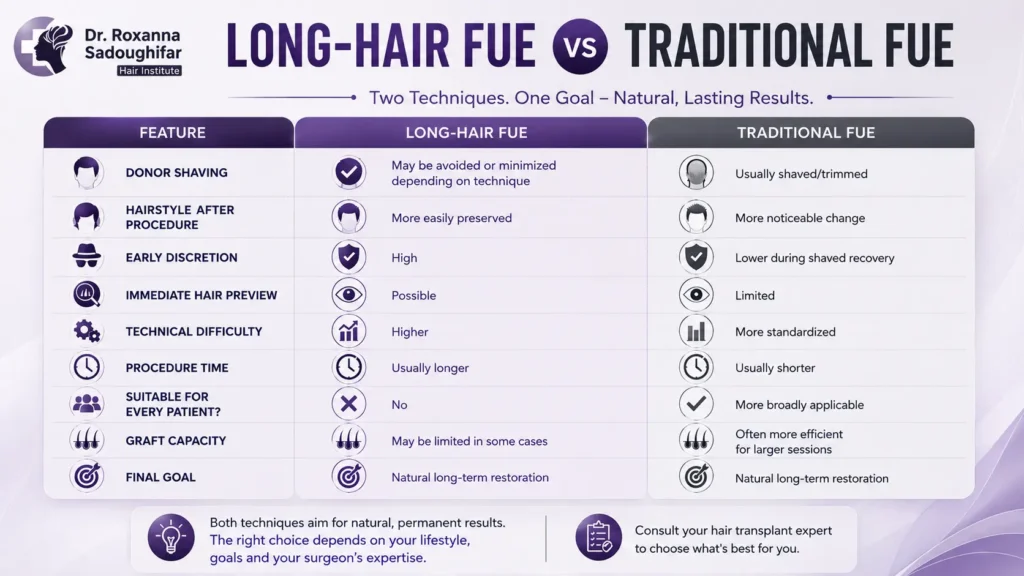
Research and clinical literature describe long-hair FUE as technically demanding because working around long hair can make graft extraction and placement more difficult and time-consuming than conventional shaved FUE.
Why Choose a Hair Transplant Without Shaving?
The biggest attraction of Long-Hair FUE is discretion. Many patients do not want colleagues, friends, relatives, or clients to immediately notice that they have undergone a hair transplant. Keeping the existing hair longer can help camouflage extraction and recipient areas during the early recovery period.
Long-Hair FUE Benefits :
- No traditional full donor-area shave in appropriately selected cases
- A more discreet appearance immediately after treatment
- Ability to maintain your preferred hairstyle
- Less obvious visual change compared with a conventional shaved procedure
- A visible preview of the direction and placement of long-hair grafts
- Potentially easier transition back to professional and social activities
- Useful for patients who cannot or do not want to dramatically change their hairstyle
- Particularly attractive for smaller or carefully selected restoration procedures
The main advantage is not that Long-Hair FUE produces inherently better final growth than conventional FUE. Instead, it offers a different aesthetic and practical experience during the procedure and early recovery period.
Long-Hair FUE Gives You a Preview of the Transplant
One of the most interesting features of Long-Hair FUE is the immediate visual preview. With conventional FUE, newly transplanted grafts generally contain a short hair shaft or are trimmed, so patients cannot immediately visualize how the longer hair will look. With Long-Hair FUE, the transplanted hair can remain long.
This can help the patient and surgeon assess aspects such as:
- Hair direction
- Hair angle
- Hair flow
- Hairline appearance
- How transplanted hair blends with existing hair
- The overall visual effect of the placement
Scientific literature has specifically identified this immediate visualization as one of the major advantages of long-hair FUE. It is important to remember that this is a preview, not the final result. Transplanted hairs can shed after the procedure before the follicles enter their normal growth cycle.
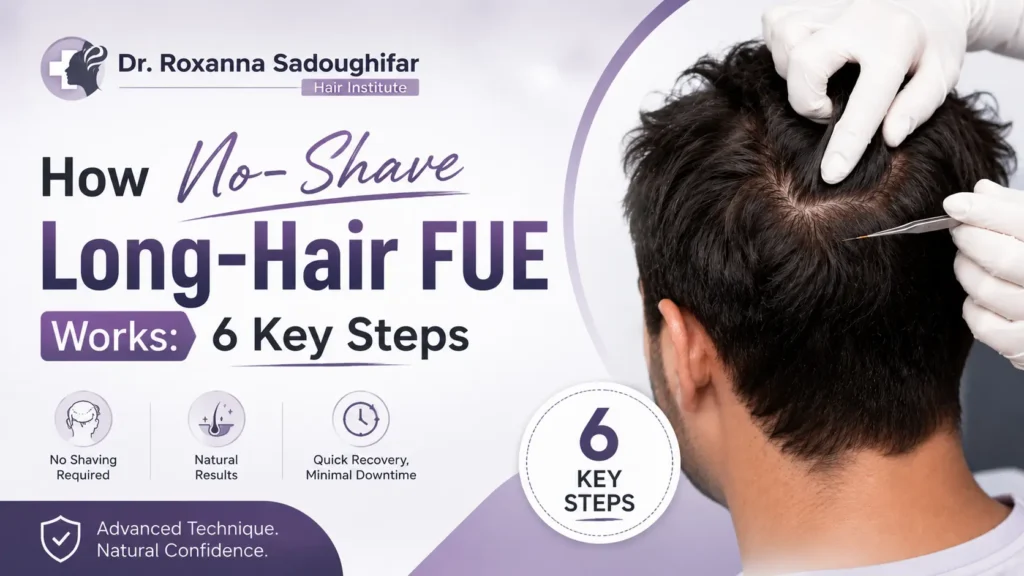
How Does No-Shave Long-Hair FUE Work?
The exact technique depends on your hair characteristics, donor density, degree of hair loss, and the number of grafts required. Generally, the process involves:
1. Detailed Hair and Scalp Assessment
Before recommending Long-Hair FUE, the surgeon evaluates:
- Pattern and severity of hair loss
- Donor-area density
- Hair calibre
- Hair direction and curl
- Scalp condition
- Existing hairline
- Expected future hair loss
- Number of grafts required
- Your desired hairstyle and cosmetic goals
Not every patient is an ideal candidate for a completely unshaven procedure.
2. Hairline and Treatment Planning
A natural-looking hairline is planned according to your facial proportions, age, existing hair characteristics, and long-term hair-loss pattern. The objective should not simply be maximum density. A successful transplant should create a result that looks natural and is designed to remain appropriate as you age.
3. Long-Hair FUE Graft Extraction
Individual follicular units are carefully extracted from the donor region using FUE principles while preserving the hair length as much as the selected technique allows. Because the surgeon is working around long hair, the procedure requires greater precision and can take longer than conventional FUE.
4. Graft Preparation
The harvested grafts are examined and prepared for implantation. The surgeon’s team aims to preserve the follicular units and organize grafts according to their characteristics.
5. Implantation
The prepared grafts are placed into the recipient area according to the planned hairline, angle, direction, and density. Long-hair grafts can provide an immediate visual indication of how the transplanted area may appear.
6. Recovery and New Hair Growth
The visible long hairs do not necessarily remain permanently attached to the transplanted follicles. Some transplanted hairs may shed during the normal hair-growth cycle. The follicles then enter their growth phase, with new hair gradually developing over the following months. Final maturation takes time, and patients should judge their transplant based on long-term growth rather than the immediate postoperative appearance.
Who Is a Good Candidate for Long-Hair FUE?
Long-Hair FUE may be particularly attractive to patients who:
- Do not want to shave their hair
- Have medium-to-long existing hair
- Want a discreet hair transplant
- Work in a public-facing profession
- Have an important event or professional commitment
- Want to maintain their existing hairstyle
- Need restoration of the hairline or selected thinning areas
- Have an adequate donor supply
- Understand that the technique may take longer and can have graft-number limitations
A consultation is essential because “no-shave” does not automatically mean that every patient can have a completely unshaven procedure. Depending on the patient’s hair characteristics and surgical plan, some techniques may involve limited trimming or other modifications that are concealed by surrounding hair.
Is Long-Hair FUE Suitable for Advanced Baldness?
Not necessarily. One of the most important things patients should understand is that Long-Hair FUE is not simply a replacement for conventional FUE in every situation.
Large transplant sessions can be more difficult when working through long hair. The technique may require more time and can sometimes limit the number of grafts that can be efficiently harvested and implanted.
For patients with extensive baldness or who require a very large number of grafts, the surgeon may recommend conventional FUE, a partially shaved approach, or another treatment strategy.
The best procedure is the one that provides the safest and most predictable long-term result—not necessarily the one requiring the least shaving.
Is Long-Hair FUE Really Scarless?
No hair transplant technique should be described as completely scarless. FUE uses small punches to extract individual follicular units. These extraction sites heal as small marks, and their visibility depends on factors such as punch size, healing characteristics, donor density, extraction pattern, and future hairstyle.
Long surrounding hair can help camouflage these areas, but it does not eliminate the underlying tissue changes created by graft extraction.
This is why proper donor-area planning and avoiding excessive harvesting are extremely important.
Long-Hair FUE Hair Transplant Cost in Tehran, Iran
The cost of a Long-Hair FUE hair transplant in Tehran varies from patient to patient.
There is no responsible single price that applies to everyone because the total cost depends on the treatment plan.
Factors that can influence the price include:
- Number of grafts required
- Size of the recipient area
- Donor-area characteristics
- Hair-loss stage
- Complexity of the procedure
- Long-Hair FUE technique selected
- Surgeon expertise
- Surgical time
- Additional treatments included in the treatment plan
- Whether the patient is traveling internationally to Tehran
Long-Hair FUE can cost more than conventional FUE because it is a technically demanding procedure that may require additional surgical time and specialized techniques.
Why You Shouldn’t Choose a Clinic Based Only on Price
Hair transplantation is a long-term aesthetic procedure. A cheaper procedure does not necessarily mean better value. The surgeon’s experience, donor management, hairline design, graft handling, implantation strategy, and long-term treatment planning can have a major impact on the final appearance.
For international patients, the overall decision should include surgeon expertise, clinic standards, treatment planning, aftercare, communication, and expected results—not only the quoted price.
Long-Hair FUE in Tehran, Iran at Dr. Roxanna Sadoughifar Hair Institute
At Dr. Roxanna Sadoughifar Hair Institute in Tehran, patients can discuss advanced hair restoration options with Dr. Roxanna Sadoughifar, a hair transplant surgeon with 16 years of experience in hair transplantation, according to the clinic’s stated professional profile.
The clinic focuses on personalized hair restoration planning rather than using exactly the same technique for every patient.
For patients interested in Long-Hair FUE, the consultation should determine whether a no-shave approach is appropriate based on the donor area, existing hair length, pattern of hair loss, graft requirements, and desired result.
The institute’s website describes Dr. Roxanna Sadoughifar as a dermatologist and hair transplant surgeon in Iran and highlights personalized hair transplantation in Tehran.
Frequently Asked Questions
In selected cases, yes. Long-Hair FUE is specifically designed to minimize or avoid the conventional shaved appearance. However, suitability depends on your hair length, donor area, hair-loss pattern, and the number of grafts required.
FUE is performed with local anesthesia, so significant pain during the procedure is generally minimized. Some patients may experience temporary soreness, tightness, swelling, redness, or sensitivity after treatment.
Not necessarily. The visible hair shaft can shed as part of the normal post-transplant cycle. The transplanted follicle remains and can subsequently produce new hair.
One advantage of the no-shave approach is that the existing hair can help camouflage early signs of treatment. However, recovery varies between patients, and redness, swelling, crusting, or other temporary changes may still occur.
Not automatically. Long-Hair FUE offers advantages for patients who prioritize discretion and maintaining their hairstyle. Conventional FUE may be more appropriate for patients requiring larger graft numbers or greater surgical efficiency. The best technique depends on the individual patient.
It can be suitable for selected women, particularly those who strongly prefer to preserve their hairstyle. However, candidacy depends on the pattern and cause of hair loss, donor density, and treatment goals.
Yes, in appropriately selected patients. The long-hair preview can be particularly useful for assessing hair direction, angle, and the visual relationship between transplanted and existing hairs.
There is no universal price. The cost depends on the number of grafts, complexity, technique, surgeon, and individual treatment plan. A personalized consultation is the best way to receive an accurate quotation.
If you want a hair transplant but the idea of shaving your hair is stopping you from moving forward, Long-Hair FUE may be worth discussing with an experienced hair transplant surgeon.